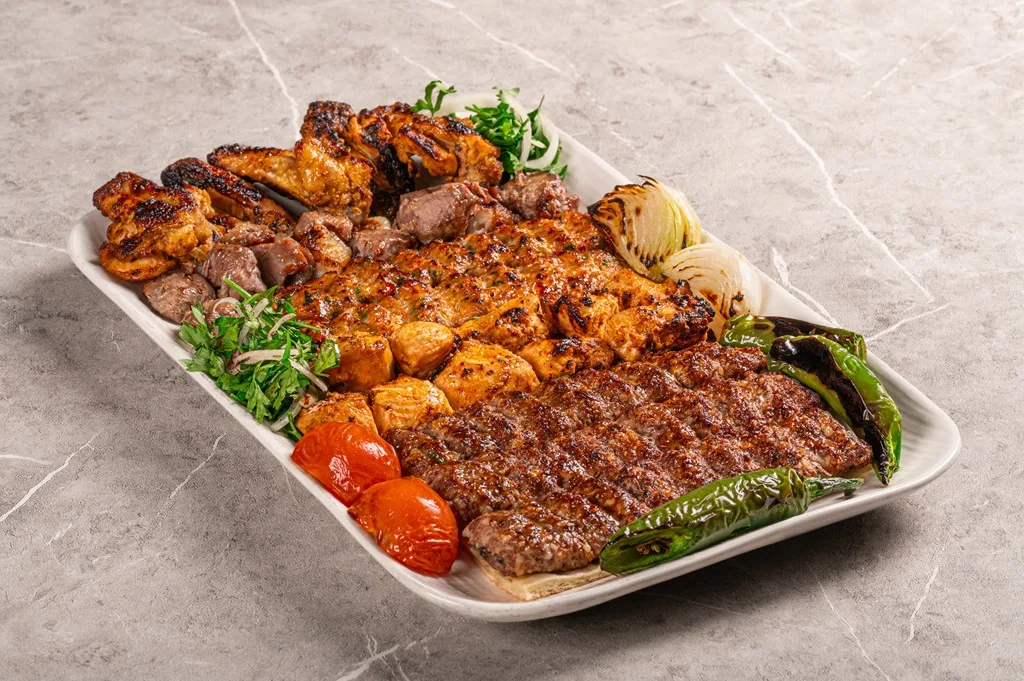
The core difference is in three things: the mince, the additions and the fire. Iraqi kebab is coarsely minced, has no bread or binders added, and is grilled directly over charcoal, so its texture is close to a piece of meat. Turkish kebab is minced finer, usually contains more spices and fillers, and is served in many styles such as Adana and Urfa.
| Element | Iraqi kebab | Turkish kebab |
|---|---|---|
| Mince | Coarse, minced daily | Fine, closer to a paste |
| Additions | No bread, egg or binders | Often bread or fillers |
| Spices | Onion, parsley, salt, black pepper | Red pepper, sumac, cumin, garlic |
| Fire | Direct charcoal coals | Charcoal or gas by restaurant |
| Serving | Tanoor bread, sumac onion, grilled tomato | Pide bread, rice, yoghurt or salad |
| Taste | Clear meat and smoke | More pronounced spice |
Because the goal is different. A coarse mince keeps the texture of the meat noticeable under the teeth and lets the fat melt slowly over the coals, moistening the meat from within. A fine mince gives a uniform, paste-like texture that suits other styles but is not what someone used to Iraqi kebab is looking for.
This is also why there are no binders: a coarse mince with the right fat ratio and hand-pressing is enough to hold the meat on the skewer. Adding bread solves a problem that does not exist if the meat is good.
Levantine kebab (Aleppan and Lebanese) is close to Iraqi in its simplicity but often more spiced, served with coriander, garlic and pine nuts in some styles.
Iranian kebab (koobideh) relies on very fine meat with onion and saffron, usually served with Iranian rice rather than bread — the closest thing to the chelow kebab we also serve.
If you are after the taste of the meat and the smoke first, Iraqi kebab is your choice. If you prefer pronounced spice and heat, Turkish kebab is closer to your taste. The two differ in aim, not in quality.
We serve Kabab Erbil the Iraqi Kurdish way since 2003, alongside a range of grills — shishlik, tikka and shish taouk — all over charcoal in Deira and Sharjah.
Not necessarily. The difference is in the type of fat and how it is used, not the amount: Iraqi kebab relies on natural lamb fat that melts over the coals, while some Turkish styles use additions that increase the texture.
After the city of Erbil in northern Iraq, where its distinctive method developed — coarse mince, hand-pressing and charcoal grilling.
Our restaurant is Iraqi Kurdish, and we serve kebab the Iraqi way. Our menu also includes Kurdish kebab, stuffed kebab, aubergine kebab and shish taouk over charcoal.