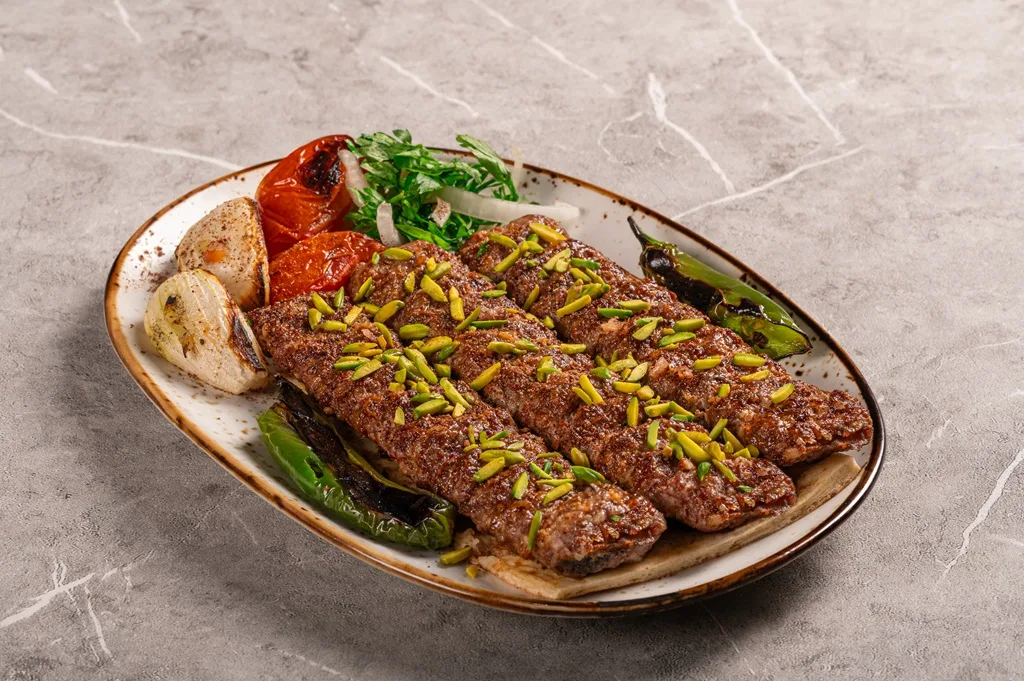
Kabab Erbil is an Iraqi Kurdish kebab made from fresh, hand-minced lamb, seasoned with onion, parsley and spices, then hand-pressed around the skewer and grilled directly over charcoal. What sets it apart is that it is mixed with no bread and no fillers, and it is served with tanoor bread, sumac onion and grilled tomato.
This kebab carries the name of the city of Erbil in northern Iraq — one of the oldest continuously inhabited cities in the world. In the kitchens of Erbil and Kirkuk a distinct way of making kebab developed, different from Baghdad or the Levant: a coarser mince, fewer spices, and an almost total reliance on the quality of the meat and the charcoal fire instead of sauces.
This is the method Azad Omar brought with him when he opened Kabab Erbil in Dubai in 2003. The name was not a marketing choice but a reference to the city the recipe came from, and to a specific way of grilling still practised at the restaurant exactly as it was.
The meat. We use fresh lamb minced in-house every day, not ready-ground meat. The fat ratio is carefully controlled — too little makes the kebab dry, too much drops it off the skewer into the coals.
The seasoning. Finely chopped onion, parsley, salt and black pepper. No bread, no egg, no binders. This is the essential difference: the kebab holds together thanks to hand-pressing and the right fat ratio, not thanks to anything added to it.
Hand-pressing. Each skewer is shaped by hand. The right pressure keeps the meat together over the fire without losing its juices — a step no machine can do, and one that takes years to master.
The charcoal. The kebab is grilled over real charcoal, never gas. Charcoal gives the meat a browned crust and a smoky flavour you cannot get any other way, which is why the grill master stands over the fire throughout service.
Iraqi kebab in general is simpler than its Turkish or Levantine counterpart, relying on the meat more than on the spices. Kabab Erbil specifically stands out for its coarse mince and the absence of fillers, which makes its texture closer to a piece of grilled meat than to a meat paste.
We have dedicated a whole page to this question if you want the detail: Iraqi kebab vs Turkish kebab.
Kabab Erbil is served hot, straight from the coals, with tanoor bread, sumac onion, grilled tomato and pepper, and salad. Many of our guests order it as part of a mixed grill, or alongside Masgouf in family orders.
Price: Kabab Erbil — AED 88.
Kabab Erbil is grilled over charcoal at both of our branches daily from 9am to 3am:
Deira, Dubai — Al Muraqqabat Street, near Union metro station. Branch details.
Sharjah — Al Taawun Street, near the Al Majaz waterfront. Branch details.
You can book a table or order delivery to most areas of Dubai and Sharjah.
Fresh lamb minced in-house every day, with a controlled fat ratio that keeps the kebab together and juicy. We use no ready-ground meat and no fillers.
No. The seasoning is only onion, parsley, salt and black pepper — mild and family-friendly. Any heat comes from the pickles and side sauces if you want it.
Yes. All meat at Kabab Erbil is 100% halal and no alcohol is served at either branch.
Kabab Erbil is coarsely minced with no bread or binders and grilled directly over charcoal. Turkish kebab is usually finer and more heavily spiced. Full comparison on our dedicated page.
Yes — we offer catering for weddings, gatherings and events, including kebab by the kilo, mixed grills and whole Quzi.