Iraqi Food in Dubai: A Complete Guide
Mohammed Azad · July 14, 2026
Mohammed Azad · July 14, 2026
Iraqi food is one of the least understood cuisines in Dubai, and one of the oldest in the world. It sits between the Levant, Persia and the Gulf, borrowing from all three while remaining distinct from each. If you've eaten Lebanese or Syrian food and assumed Iraqi would be similar, it isn't.
Here's what defines it, what to order, and how it differs from the Arabic food you already know.
Rivers, not coast. Iraqi cuisine grew along the Tigris and Euphrates. Freshwater fish sits at its centre in a way it doesn't anywhere else in the region — masgouf, the national dish, is river carp.
Sourness as a foundation. Where Levantine cooking reaches for lemon, Iraqi cooking uses pomegranate molasses, dried Basra lime and tamarind. The result is a deeper, rounder acidity that runs through dolma, tashreeb and most stews.
Rice cooked in layers. Quzi, maqluba and tashreeb are all built by layering rice with meat and broth rather than cooking them separately.
Fire over sauce. Iraqi grilling is minimal in seasoning and heavy on technique. The flavour is expected to come from the meat and the coals.
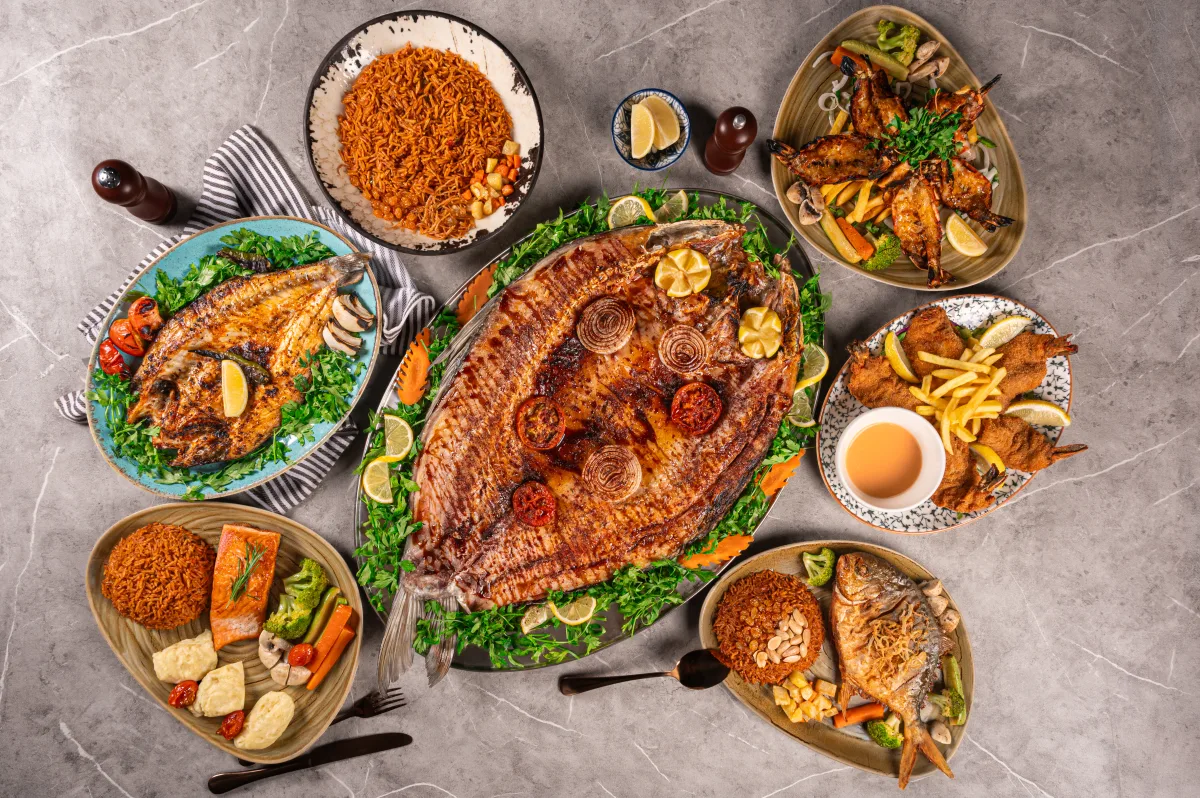
Masgouf — Iraq's national dish. A whole river fish split open and grilled upright beside an open wood fire for about an hour. Not over the fire; beside it. The slow radiant heat is the whole point.
Quzi — lamb slow-cooked for hours until it pulls apart, served over spiced rice with almonds and raisins. The dish Iraqi families order when the table is full.
Erbil kebab — coarsely minced lamb, hand-pressed onto the skewer, no breadcrumb or binder. Closer in texture to grilled meat than to the smoother Turkish or Levantine kebabs.
Dolma — not the single stuffed item you may know. Iraqi dolma layers vine leaves, onion, aubergine and courgette in one pot, sharpened with pomegranate molasses.
Kubba — bulgur or rice shells around spiced meat. Kubba Mosul is the flat, wide version; kubba Halab is rice-cased and fried.
Tashreeb — bread torn into a bowl and soaked in broth. Iraqi comfort food, eaten at breakfast and dinner alike.
This is the part most people in Dubai miss entirely. Iraqi breakfast is substantial and communal — kahi and kaymar (flaky pastry with clotted cream and date syrup), makhlama (eggs with tomato and meat), tashreeb bajila (broad beans in broth) and, on weekends, pacha. We go deeper in our guide to Iraqi breakfast in Dubai.
At Kabab Erbil we serve breakfast from 9:00 AM daily. Very few kitchens in Dubai offer the full spread.
The Iraqi community in Dubai concentrates around Deira — particularly Al Muraqqabat and Al Rigga — where you'll find the highest density of Iraqi kitchens.
Kabab Erbil Iraqi Restaurant has been on Al Muraqqabat Street since 2003, with a second branch on Al Taawun Street in Sharjah. Both cook over real charcoal, and masgouf over wood rather than gas — see our Deira branch and Sharjah branch.
Deira: 10 Al Muraqqabat Street · +971 4 272 0843
Sharjah: Al Taawun Street, Al Khalidiya · +971 6 565 8255
Open daily 9:00 AM – 3:00 AM. 100% halal.
If it's your first time: order masgouf if you have the time to wait, quzi if you're a group, and Erbil kebab if you want to understand what Iraqi grilling actually tastes like. Add dolma to share, or browse the full Iraqi menu. To go deeper on the rice dishes, read Quzi, Maqluba and Tashreeb explained.
Call ahead for masgouf. Three hours over wood cannot be shortened.
Further reading: UNESCO — Erbil Citadel · Wikipedia — Iraqi cuisine.