Guides
What Is Masgouf? Iraq's National Dish, Explained
Kabab Erbil · June 30, 2026
Kabab Erbil · June 30, 2026
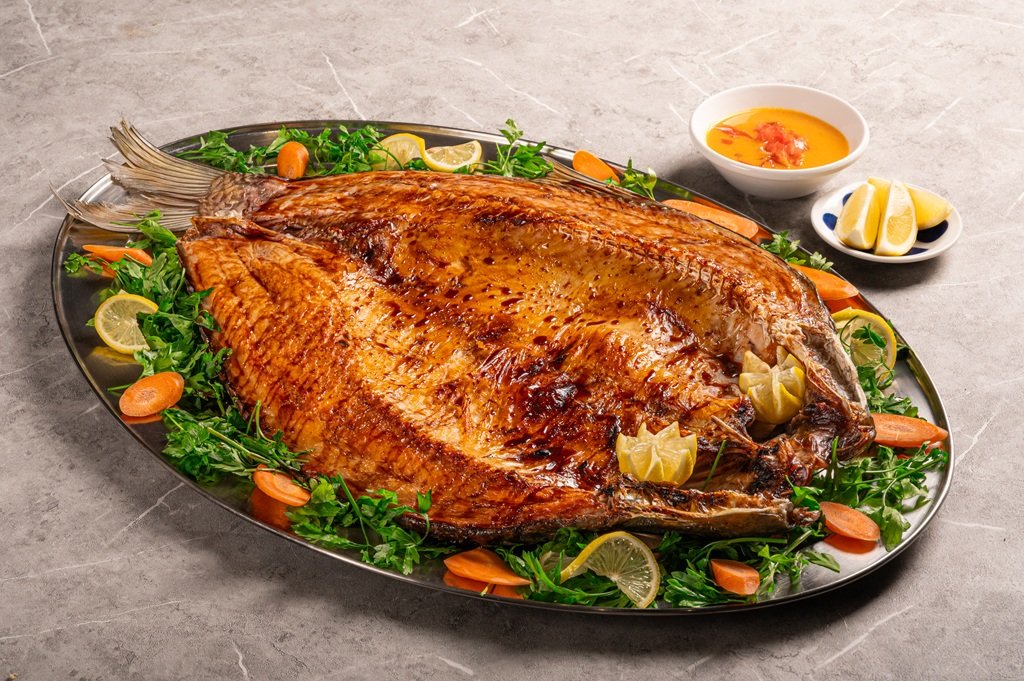
Masgouf is Iraq's national dish: a whole fish split open along the back, laid flat, and grilled upright beside a wood fire until the flesh is smoky, soft and lifts away in flakes. It takes about an hour, so it is ordered ahead and shared, usually with rice, amba and warm bread.
Masgouf (مسكوف) is a way of cooking a whole fish rather than a recipe with a long list of ingredients. The fish is cut open from the back, the bones and spine are left in to hold it together, and it is opened out like a book. It is then stood up facing a wood fire, so it cooks from the heat and smoke of the fire rather than sitting over a grill.
That one detail is what makes masgouf different from ordinary grilled fish. Cooking beside the fire, not on top of it, means the fish cooks slowly and evenly, the skin does not burn before the thick part is done, and the wood smoke has time to go all the way through the flesh. The result is soft, moist fish with a clear smoky taste.
Masgouf belongs to Baghdad and the banks of the Tigris. For generations, riverside restaurants on Abu Nuwas Street have been known for fish stood up in a ring around open fires, and in Iraqi homes masgouf is a Friday lunch for the whole family. It is the dish Iraqis abroad most often say they miss, which is why it shows up in almost every piece written about Iraqi food. Khaleej Times describes how every Iraqi dish tells a different story, and masgouf's story is the river.
In Iraq the fish is traditionally freshwater carp. Outside Iraq, cooks use the best fish available locally, and the method matters more than the species: whole, split, upright, beside wood.
The method is simple to describe and slow to do:
Because of that hour, masgouf is not a dish you order on impulse when you sit down. At our restaurant we ask guests to call ahead, so the fish goes to the fire before you arrive and comes to the table when you are ready.
Gas gives heat without smoke, so the fish tastes of nothing but itself. A charcoal grill cooks from underneath and fast, which suits kebab but dries out a whole fish before the middle is done. Burning wood gives both steady heat from the side and real smoke, and that combination is the taste people mean when they say masgouf.
| Dish | How it is cooked | Time | On our menu |
|---|---|---|---|
| Masgouf | Whole fish split open, grilled upright beside a wood fire | About 1 hour | AED 220 (half, 2.5kg) · AED 396 (whole, 4.5kg) |
| Grilled fish with rice | Grilled fish served with rice | Shorter | AED 91 |
| Zubaidi fish with rice | Zubaidi fish, fried, served with rice | Shorter | AED 100 |
If you want fish without the wait, the fried zubaidi or grilled fish are the quicker choices. If you want the dish Iraqis travel for, it is masgouf. For a full list of what to put on the table around it, see our guide to ordering at an Iraqi restaurant.
At Kabab Erbil, masgouf comes with rice, amba and bread.
Extra amba or pickles (torshi) can be added from the appetisers, from AED 28.
| Size | Weight | Serves | Price |
|---|---|---|---|
| Half masgouf | 2.5kg | 2–4 people | AED 220 |
| Whole masgouf | 4.5kg | 4–8 people | AED 396 |
For two people, a half fish with one or two small dishes is plenty. A whole fish is the centre of a family table. If you are planning for a bigger group, our masgouf-for-groups guide works through how many fish to order and what to add.
Masgouf is eaten with the hands and shared from one platter. Tear a piece of bread, use it to lift a flake of fish away from the skin, add a little amba, and eat it in one bite. The softest, smokiest meat sits along the back and near the head. Work from the thick middle outwards and the bones come away in one frame, which is why the fish is cooked whole.
Masgouf is rarely an everyday meal. It is the dish for an occasion: Friday lunch, guests arriving from abroad, a family reunion, the days of Eid. Part of the reason is size, since one whole fish is meant for a table of people. Part of it is time. A dish that needs an hour by the fire suits a long, unhurried meal where the cooking is part of the gathering.
That is still how most people eat it in Dubai and Sharjah: with family or friends, planned ahead, and with a few other Iraqi dishes around it: dolma, kubba, a plate of tikka for the children, and Iraqi tea with cardamom at the end.
Keep the other dishes light, so the fish stays at the centre. A salad, a plate of pickles and fresh herbs, and one or two small hot dishes are enough. Heavy stews and big grill platters compete with it. Our post on Iraqi bread, pickles and herbs covers what usually sits on the table beside the fish.
Three things give it away: the fish arrives whole and split open, it tastes of wood smoke, and it took time. A fish that arrives in fifteen minutes was not cooked beside a fire. We wrote a fuller checklist in six signs of real masgouf, and a closer look at the fish itself in which fish is used for masgouf.
Iraqi families brought masgouf to the UAE, and it has become one of the dishes people of every background now seek out. Emirates 24/7 told the story in how Iraq's iconic masgouf fish found a home in Dubai. Emarat Al Youm's Arabic feature, From the Tigris to Dubai, traces our family's masgouf back to 1973 in Iraqi Kurdistan, before the move to the UAE in 1999. At Kabab Erbil, masgouf is cooked at both our Al Muraqqabat branch in Deira and our Al Taawun branch in Sharjah, open daily from 09:00 to 03:00. When you are ready to eat it, book masgouf at Kabab Erbil and we will have the fire going.
It is the dish most often called Iraq's national dish, alongside dolma and quzi. No dish is more closely tied to Baghdad and the Tigris.
Because it cooks beside the fire, not over it. The gentle heat cooks a whole fish through without burning the outside, and gives the smoke time to reach the centre.
Soft, moist white fish with a strong wood-smoke flavour and a lightly crisp skin. With amba it turns sharp and fresh.
Yes. Everything we serve is 100% halal, and we serve no alcohol.
We recommend it. Call the Deira branch on +971 4 272 0843 or the Sharjah branch on +971 6 565 8255 about an hour before you arrive, or reserve a table and mention masgouf.