Guides
What to Order at an Iraqi Restaurant: 12 Dishes, Explained
Kabab Erbil · August 30, 2026
Kabab Erbil · August 30, 2026
If you are ordering Iraqi food for the first time, the twelve dishes below are the ones that define the cuisine. The short answer: start with Erbil kebab if you want something familiar, quzi if you are feeding a table, and masgouf if you want the dish Iraqis themselves would send you for. Everything else builds outward from those three.
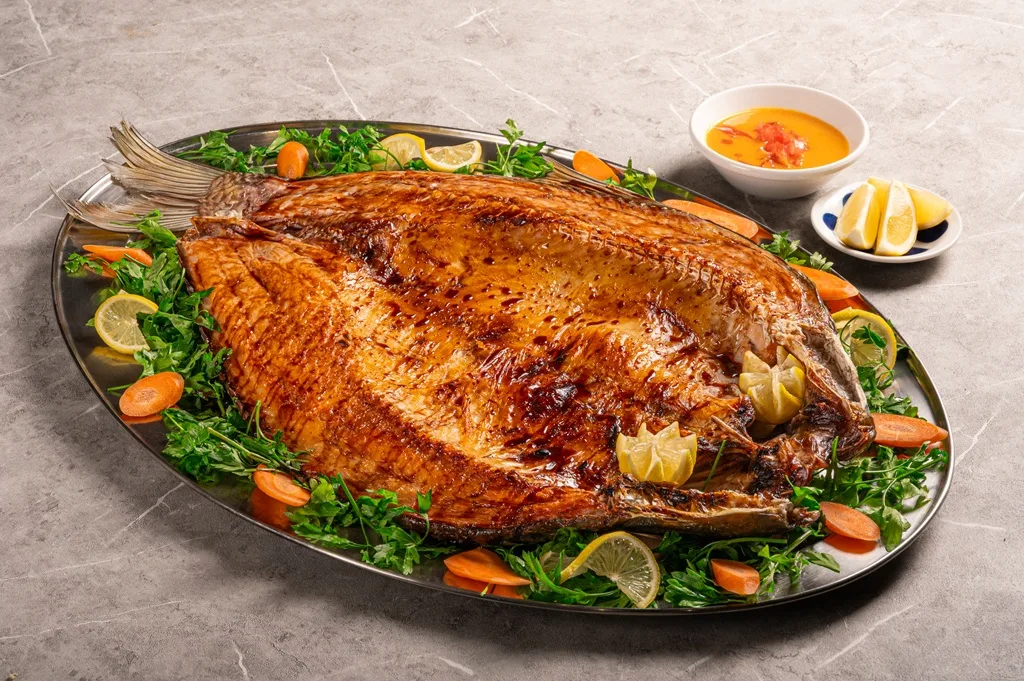
A whole freshwater fish, split open, skewered upright and slow-grilled for about an hour beside open wood coals — never over gas, and never lying flat on a grate. The result is smoky at the edges and barely set in the middle. It is served whole, on a tray, for the table to break apart. Whole fish (4.5kg) AED 396; half fish (2.5kg) AED 220.
Slow-cooked lamb served over spiced rice with toasted nuts and raisins. Quzi is what appears at Iraqi weddings and Eid tables, and it is built for sharing rather than for one person. The rice, not the meat, is what people argue about. AED 88.
Hand-minced lamb, hand-pressed onto a flat skewer and grilled over charcoal, with no binder and no filler. Iraqi kebab is deliberately coarser than Levantine kafta and is seasoned lightly so the lamb and the smoke do the work. AED 88. Order the mixed grill (AED 88) if you want kebab, tikka and chops on one platter.
Slow-simmered sheep — head, trotters and stuffed stomach — cooked for hours and served over torn bread with garlic and lemon. In Baghdad it is a weekend breakfast, eaten late morning. It is the most traditional dish on any Iraqi menu and the one most likely to be ordered by Iraqi families. AED 100. Full guide to patcha.
Vine leaves and vegetables — onion, aubergine, courgette, chard — stuffed and simmered rather than fried, usually with a sour note. Iraqi dolma stuffs a far wider range of vegetables than the Levantine version, which is normally vine leaves alone. Iraqi dolma AED 88; Erbil dolma AED 79.
Iraqi kubba comes in regional forms that look nothing alike. Mosul kubba is a wide flat disc, quite unlike the torpedo-shaped Levantine kibbeh; some Iraqi versions use rice or bulgur shells and are boiled in broth rather than fried. Mixed kubba (6 pcs) AED 67; Mosul kubba AED 72.
Not a dish so much as a method: flatbread torn into a bowl and soaked in hot broth until it softens, with the meat served on top. The bread is the base of the meal, not a side. Lamb tashreeb AED 88.
A tray built around kahi — flaky pastry — with geymar, the thick clotted cream that goes on it, plus eggs, cheese and bread. Served from 09:00 daily at both branches. Full tray AED 235.
| Ordering for | Suggested | Roughly |
|---|---|---|
| One person | Erbil kebab + rice + a starter | AED 110–140 |
| Two people | Mixed grill + dolma + starters | AED 200–260 |
| Family of four | Quzi + mixed grill + kubba + salads | AED 350–450 |
| A table wanting the full thing | Whole masgouf + quzi + starters | AED 600+ |
Prices above are food only. Online orders add AED 20 delivery and 5% VAT at checkout.
Not in the chilli sense. It is aromatic rather than hot — baharat, cinnamon, cardamom and dried lime do the work. If you find Indian or Thai food too hot, Iraqi food will not be a problem.
Yes. Everything at Kabab Erbil is 100% halal and no alcohol is served.
"Arabic" and "Middle Eastern" are umbrella terms covering Lebanese, Syrian, Egyptian and Gulf cooking. Iraqi cooking sits inside that umbrella but is built differently — rice and stews rather than a mezze table, and dried lime, tamarind and river fish rather than sumac, olive oil and the coast. We set the differences out in Iraqi vs Lebanese vs Syrian food.
Kabab Erbil has served Iraqi food since 2003, from 10 Al Muraqqabat Street in Deira (near Union Metro) and Al Taawun Street in Sharjah. Both branches open daily 09:00–03:00. You can order any of these dishes online for delivery across Dubai and Sharjah, or see the full menu with prices.