Guides
Iraqi vs Lebanese vs Syrian Food: What Is Actually Different?
Kabab Erbil · August 23, 2026
Kabab Erbil · August 23, 2026
Iraqi, Lebanese and Syrian food are grouped together as "Middle Eastern" on most menus, but they are built on different foundations. Lebanese cooking is a mezze culture built on olive oil, lemon and herbs. Syrian cooking shares that base and adds Aleppo's pepper and nut work. Iraqi cooking is a rice-and-stew culture built on dried lime, tamarind and river fish — closer to Persian and Mesopotamian cooking than to the Mediterranean coast.
In a Lebanese or Syrian meal, the centre of gravity is the mezze table — many small dishes, eaten together, largely cold or room temperature, with grills arriving later. In an Iraqi meal, the centre of gravity is one large hot dish, usually over rice, shared from the middle of the table. Quzi is the clearest example: a whole slow-cooked lamb over spiced rice, and the rest of the table arranges itself around it.
This is why an Iraqi restaurant menu looks different even when the dish names overlap. The appetisers are a prelude, not the point.
Three ingredients mark Iraqi cooking out immediately, and none of them are common in Lebanese or Syrian kitchens:
Conversely, sumac, za'atar and heavy olive oil finishing — the Levantine signature — are comparatively rare in Iraqi cooking.
Where the same word appears on all three menus, it usually means different things:
Not in the chilli-heat sense. It is heavily aromatic — baharat, cinnamon, cardamom, dried lime — but rarely hot. Levantine food is generally lighter and more herb-forward; Iraqi food is deeper and more warmly spiced.
If you already know Lebanese food, the Iraqi dishes that will feel most familiar are the charcoal grills. The ones that will feel genuinely new are masgouf, quzi and patcha. Our guide to Iraqi food in Dubai sets out an order to try things in.
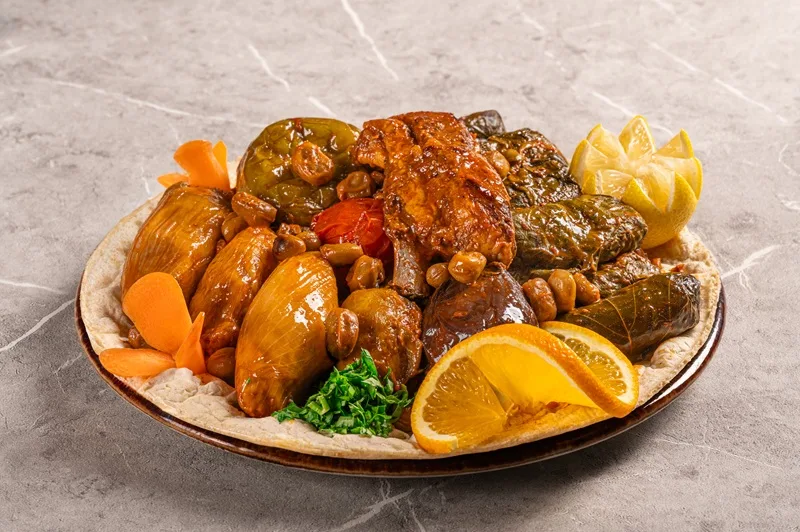
Overlapping, not identical. Kurdish cooking from the Erbil region shares the rice-and-stew structure and the grill tradition, with its own emphasis — more yoghurt, more mountain herbs, and its own dolma style. Kabab Erbil cooks both, which is why the menu carries Erbil dolma alongside the Baghdadi dishes.
Deira is where the Iraqi community in Dubai eats, and Al Muraqqabat Street in particular — we wrote a whole guide to eating on that street. Kabab Erbil has been there since 2003, with a second branch on Al Taawun Street in Sharjah.
If you order Iraqi food expecting a Lebanese meal you will be disappointed, and the reverse is equally true. They are not better or worse versions of each other — they are separate traditions that happen to share a region and some vocabulary. Iraqi cooking rewards patience: the dishes that define it are the ones that take two hours or six.
You can see the whole range on our Iraqi menu, or order online for delivery across Dubai and Sharjah. For the historical backdrop, UNESCO's entry on the Erbil Citadel — one of the longest continuously inhabited sites on earth — is worth reading.