Heritage
Masgouf or Masgoof? A Spelling Guide to Iraqi Dish Names
Kabab Erbil · September 26, 2026
Kabab Erbil · September 26, 2026
Iraqi dish names have no fixed English spelling, because Iraqi Arabic uses sounds — a hard g, ch and p — that neither Standard Arabic letters nor English transliteration capture. Masgouf is also written masgoof, maskoof and mazgoof; quzi appears as qoozi or ghoozi; kubba as kubbeh or kibbeh; patcha as pacha. The glossary below covers each one.
Three things multiply the spellings. First, Iraqi speech has sounds that Standard Arabic letters do not mark: a hard g, a ch and a p. Iraqis borrow the letters گ, چ and پ to write them, but menus and phone keyboards often fall back on ك, ج and ب.
Second, one Arabic spelling can be read two ways. مسكوف is written with a k but said with a g in Iraq, so one person writes masgouf from the sound and another writes maskoof from the letter. Third, English has no agreed system for Arabic vowels, so ou, oo and u all turn up for the same sound.
| Dish | Arabic | English spellings you will see | What it is |
|---|---|---|---|
| Masgouf | مسكوف · مسگوف · مزگوف | masgouf, masgoof, maskoof, mazgoof, masqouf | Whole river fish, split and grilled upright beside a wood fire |
| Quzi | قوزي · كوزي | quzi, qoozi, ghoozi, kouzi | Slow-cooked lamb over spiced rice with nuts and raisins |
| Kubba | كبة · كبّة | kubba, kubbeh, kubbah, kibbeh | A shell of bulgur, rice or potato around spiced minced meat |
| Patcha | باجة · پاچة · باجه | patcha, pacha, pache, bacha | Slow-simmered lamb dish, traditionally a weekend breakfast |
| Tashreeb | تشريب · تشريبة | tashreeb, tashrib, tashreb | Iraqi bread soaked in hot broth, topped with meat or beans |
| Geymar | قيمر · كيمر · گيمر | geymar, gaimar, qaymar, kemar | Thick cream eaten at breakfast |
| Kahi | كاهي | kahi, kahee | Flaky layered pastry, eaten hot with geymar |
| Dolma | دولمة · دولمه | dolma, dolmeh | Vine leaves and vegetables stuffed with rice |
| Amba | عمبة · عنبة | amba, anba | Tangy pickled-mango sauce |
| Torshi | طرشي | torshi, tourshi, turshi | Pickled vegetables |
| Samoon | صمون | samoon, samoun, samun | Iraqi bread roll |
| Chelow kabab | چلو كباب · جلو كباب | chelow, chelo, chelow kebab | Charcoal kabab over buttered rice |
Easy to mistake for two spellings of one dish, but they are not. On our own menu, Quzi Lamb and Ouzi Sham are listed separately. Iraqis say quzi; ouzi is the name used in Levantine and Gulf kitchens.
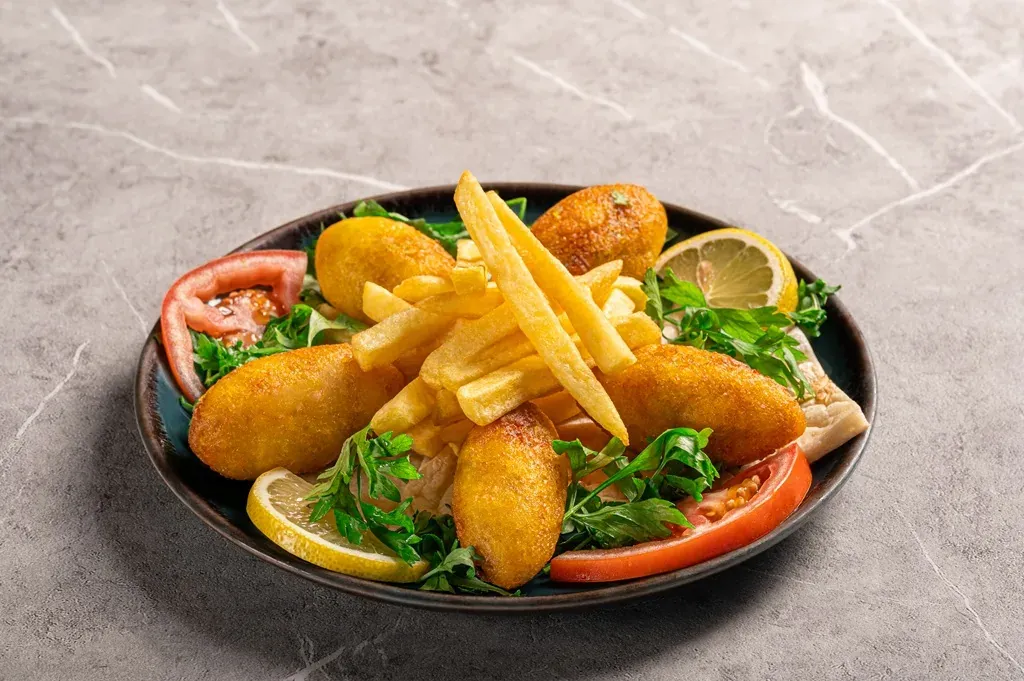
The same family. Kibbeh is the Levantine form of the word; Iraqi kubba includes versions Iraq is known for, such as the large, flat Mosul kubba.
Thareed is the old Arab name for bread soaked in broth, and tashreeb is the Iraqi dish that carries it on — the name itself means "soaking". The National's history of Iraqi food traces how old many of these dishes are.
One city, four names. Erbil, Arbil and Irbil are English spellings of the Arabic أربيل; Hawler (هەولێر) is its Kurdish name. Our restaurant, and our signature kabab, are named after it.
Search engines and delivery apps do not always connect spellings, so if one finds nothing, try another from the table — or search in Arabic, which is how most of our guests look for these dishes. On the phone, any version works: our staff know them all.
There is no single correct one. We write masgouf; masgoof, maskoof and mazgoof are the same dish.
Kemar is simply another spelling of geymar, the thick breakfast cream — the same way TasteAtlas lists it as qaymar. Same cream, different letters.
No. The names look alike, but on our menu they are separate dishes.
Yes. Patcha, pacha, pache and bacha are all the same dish; in Arabic it is written باجة, and in Iraq often پاچة.